
The Visible Reader
Why the simple act of opening a book still carries power

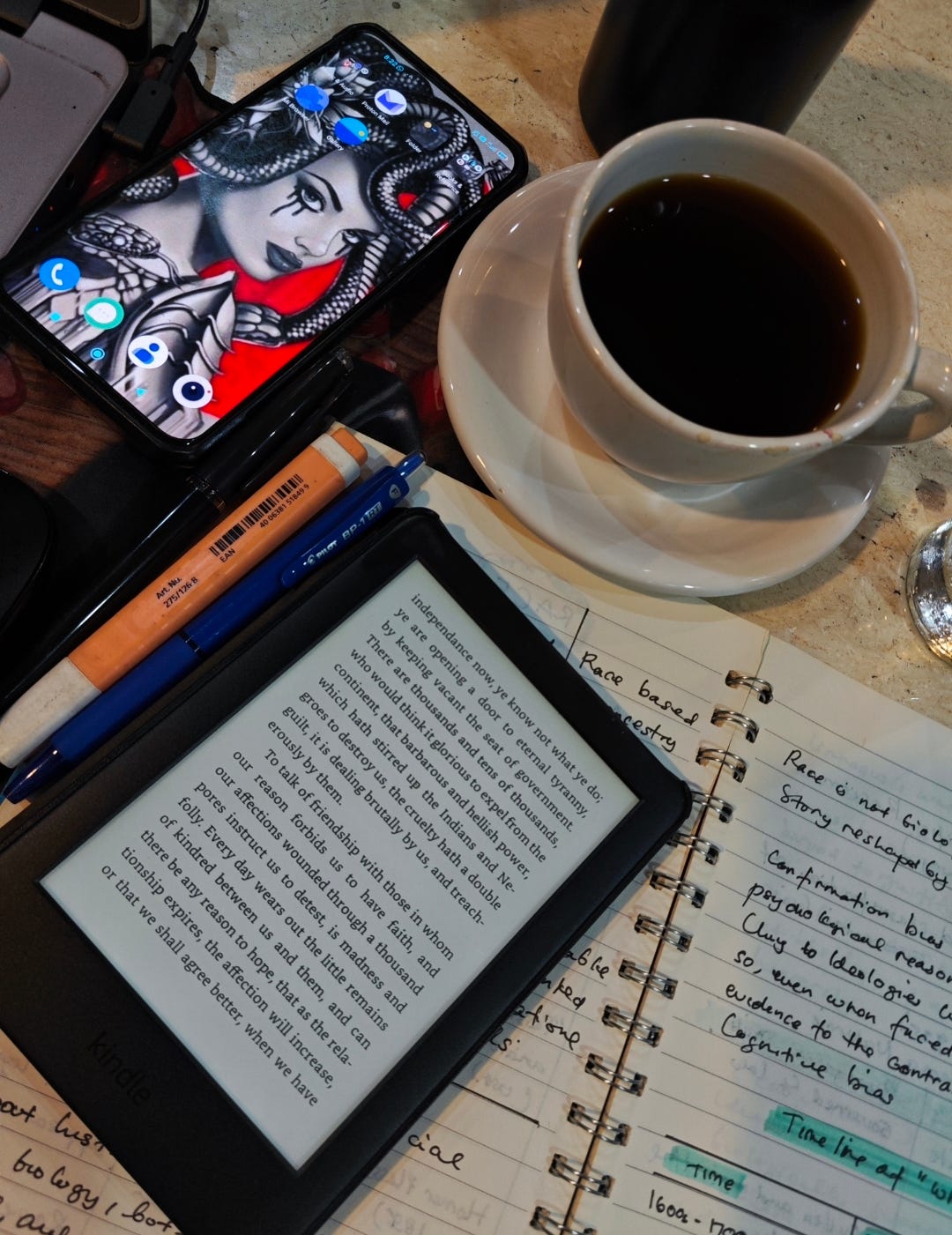
On a quiet afternoon in a café, someone sits alone with a book.
Not a phone, not a tablet. A book. Thick enough that its spine curves slightly when opened. Their coffee cools slowly while their eyes move line by line across the page.
Around them, the room moves differently. Screens glow in people’s hands. Fingers scroll. Notifications pulse and vanish. Conversations rise and fall in short bursts.
But the reader stays still.
You notice them.
Most people do.
Something about a person reading in public draws attention. Not always admiration. Sometimes curiosity. Sometimes suspicion. Occasionally even irritation.
Why?
Because reading has never been just a private act. It has always carried meaning beyond the page. And in a world saturated with constant visibility, where identities are performed, curated, and measured, the act of reading quietly in public begins to signal something.
To be seen reading can suggest intelligence. Or aspiration. Or cultural taste. Sometimes it signals nothing more than boredom.
But whatever the intention, the visible reader communicates something about themselves. And people instinctively react to signals.
The Social Life of Reading
It is tempting to imagine reading as an entirely personal activity, an intimate conversation between the mind and a text. But historically, reading has always been deeply social.
For centuries, access to books determined who could participate in intellectual life. Literacy separated social classes. Education systems decided which texts would shape future citizens. Governments banned certain works and celebrated others.
Books have never existed outside power.

The language you read in, the authors you encounter, the ideas you are encouraged to take seriously, all of these are shaped by institutions, politics, and cultural hierarchies.
Even the literary canon itself is not simply a collection of “great works.” It is also the product of decisions: which voices were preserved, which traditions were translated, which perspectives were excluded.
Reading has always been a gateway into these structures.
When someone reads in public today, they are not just passing time. They are participating, consciously or not, in a long historical relationship between knowledge, authority, and cultural belonging.
The Suspicion of Intellectual Signals
Because reading carries symbolic weight, people often interpret it socially.
When someone holds a philosophy book on a train or posts a carefully arranged bookshelf online, observers begin asking silent questions.
Are they genuinely interested in these ideas?
Or are they trying to look intelligent?
The suspicion is not entirely irrational. Humans constantly signal identity through taste. What we watch, wear, listen to, and read helps position us within cultural groups.
The sociologist Pierre Bourdieu described this phenomenon as cultural capital, the way knowledge, aesthetic preferences, and intellectual habits function as social currency.
Taste communicates belonging.
Owning certain books, referencing certain thinkers, or displaying intellectual interests can signal education, class background, or ideological alignment. In that sense, reading does participate in the performance of identity.
But the suspicion that follows visible intellectuality often misses something important.
Human motivations are rarely pure.
A person might begin reading partly out of curiosity and partly out of social aspiration. They might enjoy the identity associated with intellectual culture while also genuinely engaging with the ideas themselves.
And sometimes the performance leads somewhere real.
A person may first pick up a difficult book because they want to appear thoughtful. But the ideas inside the book might eventually reshape how they see the world.
Identity and behavior evolve together.
The performance becomes practice.
The Attention Economy
If reading has always carried social meaning, the digital age has added a new dimension: attention itself has become a commodity.
Modern online platforms are designed to capture and maintain human attention for as long as possible. Every click, pause, reaction, and share becomes data that helps refine future predictions about what will keep users engaged.
In this environment, the architecture of everyday life begins to favor speed over depth.
Notifications interrupt concentration. Feeds refresh endlessly. Information arrives in fragments designed to provoke quick emotional reactions.
This system does not operate through force. It operates through convenience.
You scroll because you want to.
You watch because it feels interesting.
You stay because leaving requires effort.
Comfort becomes the mechanism of control.
Over time, this environment subtly reshapes cognitive habits. Novelty becomes more attractive than sustained attention. Quick emotional responses become easier than slow reflection.
Long reading begins to feel strangely demanding.
But that difficulty reveals something important about what reading actually requires.
The Cognitive Pace of Books
A book moves at a human pace.
It does not adapt itself to your impulses. It does not change its structure based on your attention patterns. It unfolds according to its own logic, asking the reader to follow arguments, imagine scenes, and reflect on ideas over extended periods of time.
This pace is fundamentally different from the rhythm of digital media.
Reading demands patience.
It requires the mind to remain with a thought long enough for complexity to appear. It tolerates ambiguity. It invites the reader to sit with uncertainty instead of immediately resolving it through emotional reaction.
These cognitive habits - patience, ambiguity tolerance, sustained attention - are increasingly rare in environments optimized for rapid engagement.
Which is why reading today can feel almost subversive.
Not because books are inherently radical, but because the act of deep attention itself has become unusual.
Narrative Power
Reading also intersects with another form of power: the power to shape narratives.
Ideas rarely circulate freely through society. They move through institutions, media systems, and cultural frameworks that determine which voices are amplified and which are ignored.
The philosopher Michel Foucault argued that what societies recognize as truth is often produced within these structures. Knowledge becomes legitimate not only because it is accurate, but because it is validated by institutions capable of granting authority.
Language plays a crucial role here.
Political slogans, simplified media narratives, and viral phrases compress complex realities into emotionally powerful fragments. Digital platforms accelerate this process because short, emotionally charged messages travel faster than careful arguments.
Over time, public discourse becomes fragmented.
Different groups begin to trust different sources of information. Facts are interpreted through ideological lenses. Reality itself becomes contested.
In this environment, reading critically becomes more than an intellectual exercise. It becomes a method of navigating narrative power.
To read carefully is to slow down the consumption of information long enough to examine its structure. Who is speaking? What assumptions are embedded in the argument? Which perspectives are missing?
Reading trains the mind to ask those questions.
The Interior Space
Return again to the person in the café.
They turn another page.
For a moment, their attention belongs neither to the surrounding room nor to the endless flow of digital information circulating beyond it. Their mind is engaged with a set of ideas that require concentration, imagination, and reflection.
This small space, this interior attention is one of the few places where individuals can still encounter ideas outside immediate algorithmic mediation.
It is not perfectly independent. Books are also products of culture and market systems. Authors have their own biases. Publishers shape which voices reach the public.
But reading still opens a space where thought unfolds more slowly, where arguments stretch across pages instead of seconds.
In that space, the reader becomes less predictable.
Systems can track behavior patterns and estimate probabilities. They can predict what kind of content will hold someone’s attention for a few seconds longer.
But they cannot easily predict what happens when a person encounters an idea that unsettles them, lingers in their thoughts, and gradually reshapes how they see the world.
That transformation happens quietly.
Often invisibly.
The Quiet Resistance of Thought
The visible reader is not necessarily making a political statement.
They are not protesting anything. They are not declaring intellectual independence to the room around them.
They are simply reading.
Yet in a culture built on speed, distraction, and constant reaction, the act of sustained attention becomes quietly significant.
Reading resists acceleration.
It rewards patience instead of novelty. It favors depth over immediacy. It invites reflection where quick judgment would be easier.
These qualities do not overthrow systems of power. But they cultivate something more subtle: interior freedom.
The freedom to encounter ideas without immediately converting them into public performance.
The freedom to question narratives before repeating them.
The freedom to sit with complexity long enough to think.
The Reader and the Future of Thought
As digital systems continue to shape how information circulates, the habits cultivated by reading become increasingly important.
Societies depend not only on the availability of information, but on the ability of individuals to process that information thoughtfully.
Critical reading slows down the speed at which narratives take hold. It interrupts the automatic adoption of beliefs. It reminds the mind that ideas deserve examination.
None of this guarantees wisdom. Readers can still misunderstand, misinterpret, or cling to their own biases.
But the practice of reading creates conditions where deeper thinking remains possible.
And those conditions matter.
Because throughout history, the most profound shifts in culture and politics have often begun quietly in moments when individuals encountered ideas that changed how they understood the world.
A Quiet Figure at a Table
In the café, the reader closes the book.
Outside, the city continues moving at its familiar pace. Screens light up. Conversations start and stop. Information flows endlessly across invisible networks.
The reader stands, places the book into a bag, and steps back into the noise of the world.
No one applauds.
Nothing dramatic has happened.
But inside that person’s mind, something may have shifted slightly, a question formed, an assumption challenged, an idea planted that will continue growing long after the café is empty.
And that small interior movement, repeated across thousands of quiet readers in thousands of ordinary places, remains one of the most powerful and unpredictable forces in human history.
Because systems can shape behavior.
But thought - slow, reflective, patient thought - still begins in silence.
Yes, I will read more. Thank you for validation of a sacred act.
oh to read .. and to be lost and to be found .. and smile in and for that wonderland ..