
The Invisible Reader
We no longer recognize what thinking looks like

On a bus, an older man watches a young woman staring at her phone.
He sighs. Shakes his head. Maybe even says something about “kids these days.” No attention span. No discipline. No seriousness.
What he doesn’t know is that she might be reading . Or scrolling through a dense essay. Or annotating a passage she doesn’t fully agree with.
From the outside, it looks like distraction.
From the inside, it might be thought.
And that gap between what is seen and what is actually happening is where something important has quietly changed.
When thinking had a shape, there was a time when thinking was visible.
A book in your hands meant something. A newspaper folded under your arm meant something. Even a notebook filled with scribbles signaled effort, attention, engagement.
Thinking had a form you could recognize.
You could look at someone and assume accurately, well most of the time that they were doing something cognitively serious.
That visibility created trust.
It wasn’t just about reading. It was about being seen thinking.
The problem with screens
Now, everything looks the same.
A phone in someone’s hand could mean anything:
reading philosophy
arguing in a comment section
watching short videos
doing absolutely nothing meaningful
The object no longer tells you the activity so people fill in the gap with assumption.
And most of the time, the assumption is not generous.
They assume distraction. They assume passivity. They assume decline.
Not because they are entirely wrong, but because the signal has disappeared.
Ambiguity makes people uncomfortable.
Humans rely on visible cues to make quick judgments.
We don’t just want to know what people are doing, we want to recognize it instantly.
A physical book is legible. A screen is not.
And when something becomes illegible, it becomes suspicious.
So even if someone is reading on their phone, it does not carry the same social weight as holding the physical book.
The act is the same. But the meaning is not.
But the difference is not only social. It would be easy to say this is just a misunderstanding.
It’s not.
Reading on a screen is structurally different from reading on paper.
Not morally worse. Not intellectually inferior. But different.
A physical book creates boundaries:
no notifications
no competing tabs
no immediate escape into something easier
It demands a certain kind of attention.
A phone collapses all activities into one space.
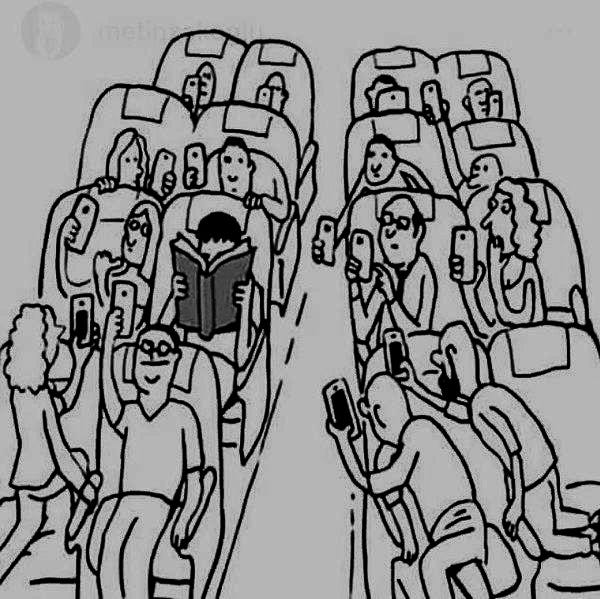
Reading competes with everything else:
messages
notifications
infinite scroll
Even if you resist distraction, you are resisting it actively.
The environment itself is unstable.
The loss of visible thinking
Here’s what’s actually unsettling people.
It’s not just that attention has changed. It’s that thinking itself has become invisible.
You can no longer look around and easily identify who is:
reflecting
concentrating
engaging deeply
Everyone looks the same: head down, screen lit, scrolling or reading, it’s impossible to tell.
And when thinking is no longer visible, people begin to assume it is disappearing.
What we lost and what we didn’t.
We did not lose reading.
We did not lose thought.
But we did lose something subtle:
We lost the shared, recognizable signal of intellectual effort.
Before, you could see it across a room.
Now, it’s hidden behind glass.
The quiet question
So when someone criticizes a young person for being on their phone, they might be reacting to something real, but not what they think.
They are not witnessing the death of reading.
They are witnessing the collapse of its visible form.
And that creates a quiet, uncomfortable question:
If thinking can no longer be recognized from the outside…
How do we know it is still happening?
The distinction between visible and invisible readers is often framed as a matter of perception, who appears to be reading and who does not. But this difference is not only social. It is also cognitive.
We like to believe that reading is a stable act, that the medium does not matter as long as words are being consumed. But the experience of reading on paper and on screens is not identical. It cannot be.
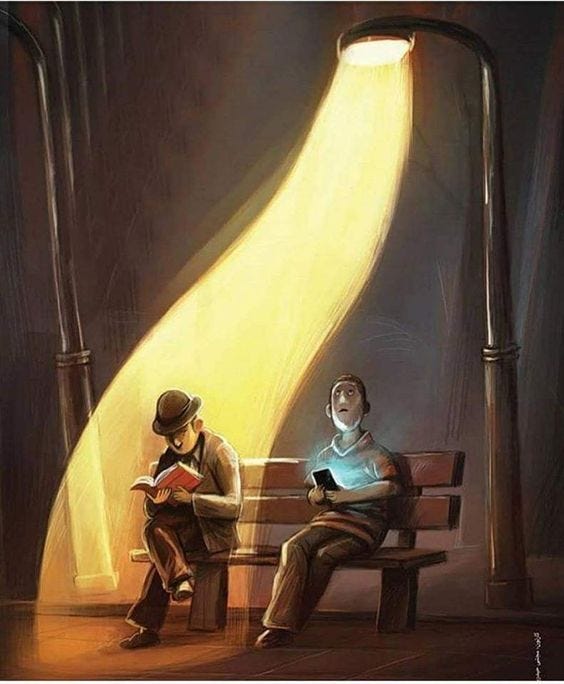
A physical book anchors the mind. It has weight, position, and geography. A sentence is not just understood, it is located. You remember not only what you read, but where it lived: the top corner of a page, the thickness of pages already turned, the quiet progress from beginning to en
On a screen, that spatial relationship dissolves. Text scrolls. It appears and disappears without resistance. There is no fixed place to return to, only a continuous stream. Reading becomes less like inhabiting a space and more like passing through it.
This is not nostalgia disguised as critique.
Research in cognitive science, including work by Maryanne Wolf, suggests that different mediums encourage different reading behaviors. Screens tend to promote speed, skimming, and fragmented attention. Physical books, by contrast, are more conducive to slower, deeper, and more reflective reading
The invisible reader, then, is not only socially unseen. They are, in a subtler sense, cognitively unmoored, reading within the same device that conditions the brain to expect interruptions.
This does not make digital reading inferior. It makes it different. Screens offer access, immediacy, and breadth. They allow us to read more, faster, and more widely than ever before. But something is exchanged in the process.
When reading becomes frictionless, it risks becoming weightless. And what is weightless is often harder to remember, harder to return to, and easier to abandoned
So the question is no longer whether someone is reading. It is what kind of reading the medium allows, and what kind of attention it demands in return
Perhaps the anxiety around reading today is misplaced.
We worry that people are no longer reading because we no longer see it. No more dog-eared paperbacks on buses, no more long afternoons with a book held open in plain sight. The reader, it seems, has disappeared.
But the truth is less dramatic and more unsettling. Reading has not vanished. It has dissolved into the same space as everything else, notifications, headlines, endless streams of information competing for the same fragile attention.
The reader did not disappear. The environment did.
And in that environment, reading is no longer a separate act. It is just one activity among many, stripped of its boundaries, its rituals, its visible commitment. It happens between distractions, not in spite of them.
So the question is no longer whether we read in public or in private, on paper or on screens. The question is whether we still know how to give our full attention to anything at all.
Because reading was never just about absorbing words. It was about staying, lingering with an idea long enough for it to unsettle you, challenge you, or change you.
That kind of reading requires resistance. It requires time, effort, and a willingness to remain when leaving would be easier.
And perhaps that is what feels different now.
Not that we read less, but that we stay less.
So very true! Thanks for sharing the article.