
Beyond the Watchmaker: From Paley to the Big Bang to Spinoza
A Tale of Two Universes

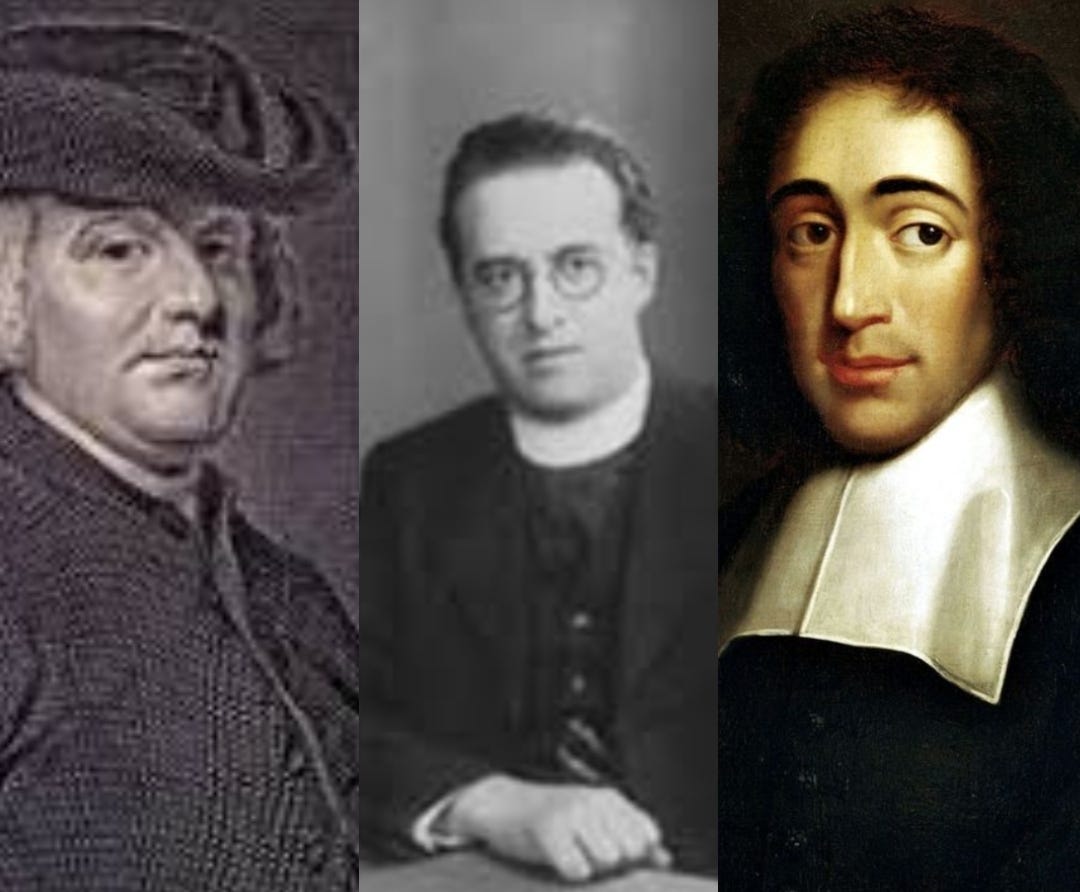
When William Paley penned his famous analogy of the watchmaker in 1802, he probably didn’t imagine that his metaphor would echo through centuries of theological debate. He invited his reader to imagine walking along a lonely heath and stumbling upon a watch. Unlike a stone, which might be explained away as a simple accident of nature, a watch, intricate, precise, orderly, demands a designer. From this simple image, Paley leapt to a sweeping conclusion: if a watch requires a watchmaker, then surely the vast and complex universe must require a divine craftsman.
At first glance, it is a captivating thought experiment. Humans have always been inclined to see purpose where there is pattern, intention where there is order. But scratch beneath the polished surface of Paley’s watch and the mechanism begins to falter. For all its rhetorical charm, the watchmaker analogy is riddled with loopholes, and those loopholes have only widened in light of modern science.
The Loopholes in the Watch
The first and most glaring problem is a category mistake. A watch exists within the universe; the universe itself is not such an object. Watches are made of brass, glass, and gears, materials that already exist within time and space. The universe, on the other hand, is the container of time and space themselves. Asking who designed the universe is like asking what lies north of the North Pole: the question sounds logical only until one realizes it has smuggled in the wrong assumptions.
Then comes the matter of imperfection. If a watch is evidence of a skilled watchmaker, then what does a malfunctioning watch imply? The universe, as beautiful as it often appears, is filled with colossal inefficiencies. Vast tracts of space are utterly inhospitable, littered with deadly radiation, black holes, and galaxies forever rushing away from each other in cosmic loneliness. Even on Earth, life is precarious. Evolution thrives on waste, death, and competition. A so-called perfect designer who chooses this blueprint either lacks competence or benevolence. David Hume anticipated this critique long before Paley, writing in his Dialogues Concerning Natural Religion that the imperfections of nature argue not for an all-powerful deity but for a clumsy or indifferent one.
The third loophole is the infinite regress. If complexity implies a creator, then surely the creator, presumably far more complex than the universe itself, also demands a creator. Who, then, made the maker? To respond that “God has always existed” is to cheat the very logic of the argument. If eternal existence is permissible for God, then it should be permissible for the cosmos or for the laws governing it.
Closely tied to this is the anthropic fallacy. We look at the universe and marvel at how perfectly suited it is for our existence, as though it were built with us in mind. But this is merely retrospective illusion. Life evolved within the narrow conditions that the universe allowed, it is not the case that the universe adjusted itself for life. To think otherwise is like a puddle marveling that its hole fits its shape perfectly, not realizing that it has merely conformed to the depression in which it finds itself.
Finally, the watchmaker theory operates in an evidence vacuum. It appeals to intuition, not to data. Its reasoning is aesthetic: “this looks designed, therefore it is.” But what looks designed is not necessarily designed. Snowflakes form intricate patterns through simple chemical laws; crystals grow into delicate lattices without an architect. To ground a cosmological argument in “looks” is to mistake appearances for explanations.
As Christopher Hitchens remarked in God Is Not Great:
“That which can be asserted without evidence can be dismissed without evidence.”
The Big Bang: From Seed to Cosmos
In contrast stands the Big Bang theory, the prevailing cosmological model for the origin of the universe. What makes it compelling is not rhetorical elegance but empirical weight.
Ironically, the idea first bloomed in the mind of a Catholic priest: Georges Lemaître, a Belgian physicist whose imagination straddled both theology and mathematics. In 1927, he proposed that the universe had expanded from a “primeval atom”, a single, dense seed that burst outward to become space and time. His intuition was not a theological leap but a scientific deduction, built upon Einstein’s equations of general relativity.
What followed was a cascade of confirmations. Edwin Hubble’s observation of galaxies moving away from us revealed cosmic expansion. The abundance of light elements like hydrogen and helium matched predictions. Most dramatically, in 1965, Arno Penzias and Robert Wilson accidentally discovered the faint microwave afterglow of the Big Bang, cosmic background radiation, the whisper of the universe’s fiery birth still humming through the night sky.
Here is the remarkable twist: when Pope Pius XII tried to baptize the Big Bang as confirmation of Genesis, Lemaître himself objected. He insisted that his theory was a scientific model, not a theological endorsement. In doing so, he preserved the integrity of science from being conscripted into dogma. The universe could be holy to him personally, but its equations belonged to reason, not revelation.
The Honesty of Science
The Big Bang theory, of course, is not free of mystery. It cannot tell us what (if anything) preceded the expansion. The laws of physics, as we know them, collapse at the singularity. Nor does it pretend to answer the metaphysical question of why there is something rather than nothing. But unlike the watchmaker analogy, these are not fatal weaknesses. They are open doors.
Science thrives on ignorance honestly admitted. Each unanswered question is a frontier. Sean Carroll, the cosmologist, says it well: “Science moves forward by admitting ignorance, not by pretending it doesn’t exist.” Religion often plugs gaps with divinity; science leaves gaps as invitations. This distinction is crucial. To invoke God as the ultimate explanation is to stop the conversation. To invoke curiosity is to keep it alive.
Awe Without a Watchmaker
For the non-believer, rejecting the watchmaker does not mean rejecting wonder. On the contrary, it deepens it. To imagine that from a singularity smaller than a grain of sand, entire galaxies unfolded; that stars forged the iron in our blood and the calcium in our bones; that consciousness itself is a fleeting arrangement of atoms capable of contemplating its origins, this is awe without a deity, poetry without divine authorship.
Carl Sagan once said, “We are a way for the cosmos to know itself.” That sentiment requires no supernatural watchmaker. It requires only the courage to see that meaning does not need to be imposed from above; it can be woven from below, through experience, reflection, and discovery.
The watchmaker analogy, for all its charm, collapses under scrutiny. It mistakes categories, ignores imperfections, indulges regress, and relies on appearances rather than evidence. The Big Bang, though incomplete, rests on empirical foundations and honest humility. One offers closure through assumption; the other offers inquiry through wonder.
Whether one chooses to see the universe as a divine mechanism or a self-writing story, the facts remain: our cosmos is vast, evolving, and alive with mystery. For some, that mystery must resolve into God. For others-myself included-it is enough that it simply is.
The universe may not be a watch. But it ticks, it sings, it burns, it expands. And that is miracle enough.
Science doesn’t need these analogies. Enter Georges Lemaître, the Belgian priest-physicist who proposed the Big Bang theory. Around 13.8 billion years ago, he said, the universe expanded from an unimaginably hot, dense point. Evidence backs it up: galaxies sprinting apart, the cosmic microwave background whispering across the skies, hydrogen and helium ratios lining up perfectly with the math. As Lemaître put it, “The beginning of the world happened a little before the beginning of space and time.” Not a myth, not a watchmaker’s workshop, just physics unfolding.
But here’s the thing: even the Big Bang doesn’t close the case. It explains the how, but not the why. Why is there something rather than nothing? Why does the universe exist at all? Science gives us equations, not existential balm.
That’s where philosophy sneaks back in. Baruch Spinoza, excommunicated in the 17th century for being too honest, refused to picture God as a cosmic engineer. Instead, he wrote: “Whatever is, is in God, and nothing can be nor be conceived without God.” For him, God and Nature were the same thing. Deus sive Natura. No watchmaker above, no workshop beyond. Just the universe itself, an infinite unfolding that needs no external architect.
Spinoza: God Without a Watchmaker
I sometimes imagine Spinoza at his desk in 17th-century Amsterdam, grinding lenses for telescopes by day and grinding old theological certainties by night. He was a man excommunicated, branded a heretic, yet his heresy was nothing more than a relentless honesty: that God is not a craftsman perched above creation, nor a king issuing decrees, nor a watchmaker winding gears. For Spinoza, the very idea of God as an external agent was a human illusion, an echo of our own longing for purpose projected into the sky.
Instead, he spoke of Deus sive Natura, God, or Nature. To him, they were one and the same. Everything that exists is a mode of a single infinite substance, unfolding with necessity, neither designed nor improvised, but simply being. This is not a God who builds watches but a God who is the watch, the clock, the time, the space, and the silence in which it all ticks.
When I linger on Spinoza’s thought, I find it strangely liberating. He strips away the watchmaker’s comforting story only to offer something grander: the universe itself as divine. Not because it was designed for us, but because it exists at all. In his world, every falling leaf, every star igniting, every thought that stirs within us is an expression of that same infinite substance. He asks us to look at the world not as a manufactured artifact but as a living whole.
This, to me, is where the watchmaker theory collapses most profoundly. It insists that meaning comes only from a craftsman. Spinoza insists that meaning flows naturally from existence itself. The sacred is not behind the universe, pulling strings, it is the universe, unfolding moment by moment, indifferent yet astonishing.
And curiously, this perspective harmonizes with modern cosmology more than Paley ever could. The Big Bang does not reveal a careful artisan sketching blueprints in the void; it reveals a self-contained universe blossoming from its own laws. Spinoza would not have been surprised. He would have said: of course. The divine has no need of hammers, gears, or watchmakers. It is enough that it is.
I’ll admit, as a non-believer, Spinoza moves me in a way Paley never could. Paley tries to comfort me with design, with the promise of a hand behind the wheel. But his analogy feels too neat, too mechanical, too much like a child insisting that the stars must be lanterns hung by someone. Spinoza, on the other hand, strips away that comfort but leaves me with something richer: a universe that needs no external maker to be meaningful. Meaning is not something imposed from above, it blooms from the very fact of existence.
And when I think about the Big Bang through Spinoza’s eyes, it feels less like an explosion from nothing and more like an inevitable flowering of the infinite. The universe didn’t need to be wound up by a watchmaker; it unfolded, necessarily, from its own laws, as naturally as a tree sprouts leaves in spring. Spinoza would never have seen contradiction here. He would have nodded and said: of course. What you call physics is what I call God.
Sometimes I wonder if this is why Spinoza unsettles both believers and atheists. For the devout, his God is too impersonal, no miracles, no providence, no ears for prayer. For the strict materialist, his God-talk feels unnecessary, even decorative. Yet there’s something about his vision that captures a middle ground: a reverence without superstition, a humility without resignation. To read him is to be reminded that one can disbelieve in the watchmaker and still find the universe sacred, not because it was designed for us, but because it exists at all.
And perhaps that is where Spinoza rescues us from Paley’s broken analogy. Paley looks at the world and sees a watch that must have been wound. Spinoza looks at the same world and sees an endless unfolding, needing no hand, no workshop, no artisan, just itself. And I, caught between wonder and doubt, find myself preferring Spinoza’s silence to Paley’s ticking.
This is a really beautiful essay. Your writing has a beautiful rhythmic quality, and I love how you made these complex philosophical ideas feel accessible and intimate. Thanks for sharing it.