
Assigned
The Convenient Burden of Women in War

Someone mentioned something that makes me thinking, “war-strippers”.
It sounds like something out of a fever dream, or a very unserious war movie, but if you strip away the absurdity for a second, it actually touches on a few real dynamics about war, psychology, and propaganda.
Historically, nothing exactly like that has been a formalized battlefield tactic. Armies have used music, symbols, flags, chants, even performers, but not literal sexualized dancing in active combat zones. War is chaotic, loud, lethal. Nobody’s setting up a podium in the middle of gunfire unless they have a death wish or a very confused commanding officer.
But the idea behind what that someone was describing : using sexuality to “hype” men, does echo real things:
Morale manipulation: Armies have always tried to boost aggression and cohesion. Think war drums, speeches, or even pin-up imagery during wars. It’s about emotional stimulation, anger, pride, desire, all channeled into fighting.
Objectification as a tool: Reducing women to symbols (sexual, patriotic, or otherwise) has been a recurring theme in wartime propaganda. The “woman as reward” narrative is old and… not exactly flattering to anyone involved.
Adrenaline culture: War already runs on a cocktail of fear, testosterone, and chaos. Adding overt sexual stimulation into that mix wouldn’t “focus” soldiers, it would more likely distract, destabilize, or just feel surreal.
If someone seriously proposed “war-strippers” as a tactic, I’d file it under “psychological misunderstanding of combat behavior” or “pure spectacle fantasy rather than strategy”.
Also, bluntly: in actual battle conditions, soldiers are trying not to die. Survival overrides everything. Libido tends to take a backseat when bullets are flying.
There’s also an ethical layer here that’s hard to ignore. Turning women into tools for motivating violence pushes things into pretty dark territory, dehumanizing both the women and the men. It frames war not just as conflict, but as something fueled by base impulses rather than discipline or strategy.
So my take?
It’s not just unrealistic, it misunderstands how war actually works, and says more about the person imagining it than about warfare itself.
That said… I can see it existing in dystopian fiction. The kind where everything is grotesquely exaggerated to make a point about how far society has fallen. And honestly, if they pitched that as satire, I’d read it.
War does not begin with gunfire.
It begins with smaller gestures, quiet, ordinary, deniable.
A woman hands a man a white feather, and the meaning settles in before he can refuse it. Another stands under stage lights, smiling, reminding him what he is meant to endure for.
Somewhere else, nothing is said at all, and still, he understands.
War does not only move men. It arranges them. Before the war, women are asked to send men to it.
During the war, they are asked to keep them there. After the war, they are asked to answer for it.
War does not only move armies. It moves people, through pressure, through expectation, through carefully placed emotion.
Order of The White Feather
This one isn’t a fever dream. It actually happened, and it’s a pretty sharp example of how social pressure can be weaponized.
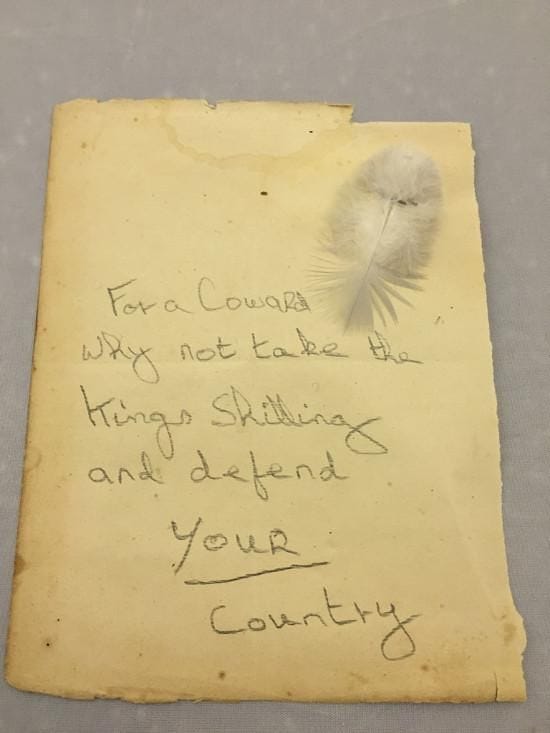
The Order of the White Feather emerged in Britain early in World War I, often associated with figures like Admiral Charles Fitzgerald and Mary Augusta Ward. The idea was brutally simple: hand a white feather, symbolizing cowardice to men out of uniform, publicly shaming them into enlisting.
And yes, young women were central to it. That wasn’t accidental.
Why it worked? It was using masculinity as leverage. In that social context, being called a coward or “not a real man” cut deep. Reputation wasn’t just personal; it was social currency.
Public humiliation. This wasn’t private persuasion. It happened on streets, in front of peers, family, strangers. Once you’re marked, you carry that stigma.
Women as moral enforcers. Having women deliver the feather amplified the shame. It tapped into a cultural script: men prove themselves in the eyes of women. Refusal became not just unpatriotic, but socially emasculating.
Family pressure, even mothers or relatives doing it, hits hardest. That turns patriotism into a kind of emotional coercion at home.
But there’s a darker, messier side people often gloss over:
It misfired badly. Men who were already serving on leave, or who were medically unfit, were sometimes targeted. There are accounts of soldiers being handed feathers while wearing civilian clothes between deployments.
It contributed to a climate where hesitation = moral failure, which is a dangerous simplification in something as complex as war.
The government later had to introduce badges like the “Silver War Badge” so wounded or discharged soldiers wouldn’t be harassed.
Did it work? yes, in the narrow sense that it pushed some men to enlist. But it worked by exploiting shame, identity, and fear of social exclusion. It’s closer to psychological coercion than noble persuasion.
And here’s the interesting connection to earlier “war-strippers” idea: both rely on women being used as instruments to regulate male behavior in wartime, just through different levers.
White Feather was about to shame you into fighting not stimulate you into fighting
Different emotional triggers, same underlying logic: manipulate male psychology using gender dynamics.
War doesn’t just mobilize armies, it mobilizes social norms, especially around gender, and bends them into tools. And once you see that, it’s hard to unsee how thin the line is between “patriotism” and pressure.
In the Order of the White Feather, a woman could stop a man in the street and hand him a symbol of cowardice. No law compelled him. No weapon threatened him. And yet the message was unmistakable.
Go…or be marked.
It was efficient. Public. Immediate.
But war does not only require men to enter it. It requires them to stay.
And shame, once internalized, is not enough to sustain endurance.
United Service Organization
It actually happened in WWII and during Korean War.
The U.S. had the United Service Organizations, which organized performances for soldiers, music, comedy, dance. Big stars participated, like Bob Hope, Marlene Dietrich and Marilyn Monroe.
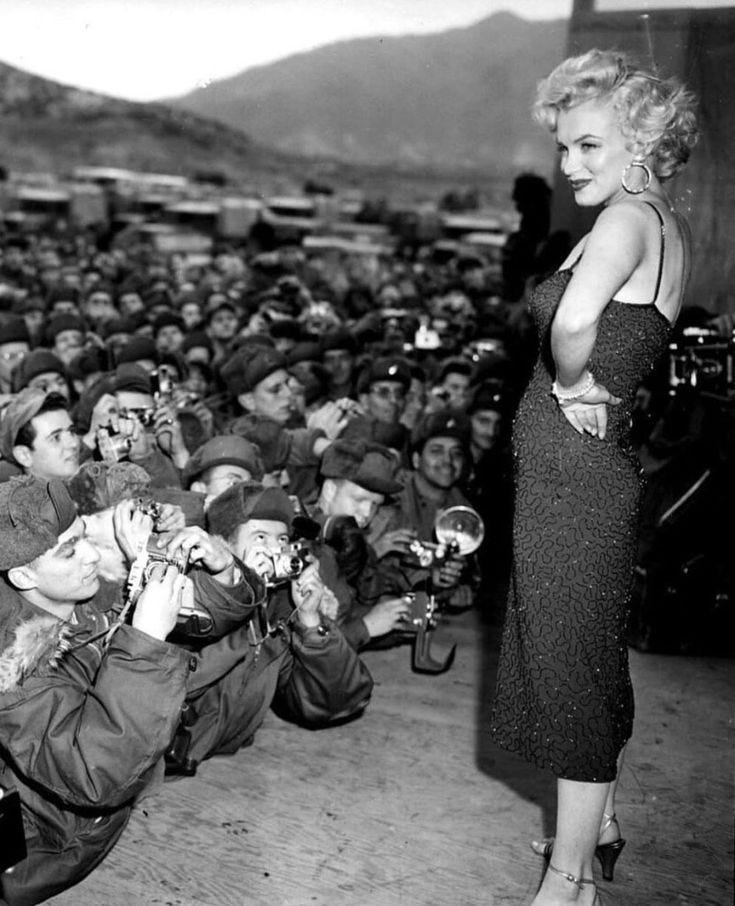
They performed near combat zones to boost morale, not to “hype men into battle” in a direct, primal way.
In 1954, Marilyn Monroe went to Korea and performed for tens of thousands of soldiers. And yes, of course by then she was Marilyn Monroe, fully formed as a sex symbol. The performances were:
flirtatious
glamorous
emotionally uplifting for homesick soldiers
But again, the purpose wasn’t “go fight harder right now.” It was:
relieve stress
remind them of home
keep morale from collapsing
There’s a pattern here, but it’s more nuanced than “weaponized sexuality”:
White Feather movement : shame and social pressure
USO / Monroe-type performances : comfort, fantasy, emotional escape
Both involve women and gender dynamics, but they operate on different emotional frequencies:
one uses humiliation and coercion, the other uses desire, nostalgia, and relief
And here’s the blunt reality:
War isn’t just fought with bullets. It’s sustained by psychology. Keeping soldiers mentally intact is as important as keeping them armed.
If anything, Monroe standing on a stage in Korea isn’t about turning men into fighters, it’s about keeping them human enough to survive the experience without breaking completely. Arguably more effective, and definitely more real.
By the time of World War II, the method had shifted. Under the United Service Organizations, women were no longer positioned as enforcers of judgment, but as carriers of something else: comfort, familiarity, the illusion of a life untouched by war.
If shame could push men forward, desire could hold them in place.
The gesture changed. The function did not.
Not every society needed a symbol as explicit as a white feather, or an institution as organized as the United Service Organizations. During the Indonesian National Revolution, there were no staged rituals of humiliation handed out in public streets. No centralized performances designed to sustain morale.
And yet, the same pressures existed.
They lived in expectation. In communities. In silence.
To fight was duty. To hesitate was to fall short of it.
The mechanism did not disappear. It became less visible.
Women, in all these contexts, were not outside the machinery of war. They were positioned within it, sometimes to apply pressure, sometimes to sustain morale, sometimes simply to embody what men were told they were fighting for.
Different roles. Same function.
And when the war ends, those roles do not simply dissolve.
They are rewritten.
The same societies that once relied on women to mobilize and sustain conflict begin the work of moral clarification. Complexity becomes inconvenient. Ambiguity becomes intolerable.
What was once participation becomes suspicion.
What was once proximity becomes guilt.
La tonte des femmes
La tonte des femmes refers to the public head-shaving of women in Liberation of France (1944–45), where thousands of French women accused of “horizontal collaboration” with German soldiers were punished by mobs. Their hair, symbolically tied to femininity and dignity, was forcibly shaved in town squares, often alongside humiliation like parading them half-naked or marking them with swastikas. What’s striking is the gendered nature of the punishment: while many men who collaborated economically or politically faced legal proceedings (or escaped scrutiny), these women were targeted as visible, moral scapegoats. It wasn’t justice in any formal sense, it was a raw, emotional purge disguised as patriotism, where the female body became a battlefield for reclaiming national honor.
Gerwani and Jugun Ianfu
Gerwani and Jugun Ianfu sit in the much darker and more politically manipulated corners of Indonesian history during and after Indonesian mass killings of 1965–66 and Japanese occupation of Indonesia. Gerwani (Gerakan Wanita Indonesia) was a leftist women’s organization later demonized by the Suharto regime, accused - without credible evidence - of sexually torturing generals during the 1965 coup narrative; this propaganda justified mass killings and the destruction of leftist movements. Meanwhile, Jugun Ianfu refers to Indonesian (and other Asian) women forced into sexual slavery by the Japanese military during WWII, a system built on coercion, deception, and violence. Both cases expose how women’s bodies are repeatedly weaponized - either through direct exploitation or through fabricated sexual narratives - to serve political control, moral panic, and historical rewriting.
As seen in the aftermath of La tonte des femmes in France and in the political destruction of Gerwani following the 30 September Movement in Indonesia, women are not remembered as part of the system that sustained war or conflict.
They are recast as its moral failure.
Not because their actions changed, but because the need for clarity did.
War does not only produce violence. It produces roles.
And when those roles are no longer convenient, they are not undone.
They are judged.
In the end, war leaves behind more than bodies. It leaves behind a narrative that must be made coherent.
Contradictions are reduced. Responsibilities are redistributed.
And those who once occupied necessary roles are reclassified into convenient ones.
This is how order is restored. Not by truth, but by rearranging it.
It is easy to call it duty or betrayal when survival was never a negotiation. The distinction matters less than we pretend.
War assigns roles long before it assigns blame. It is only afterward that the roles are forgotten, and the blame is not.
Truly something we should ponder upon...